


A conversation with
Olivier Gagnère
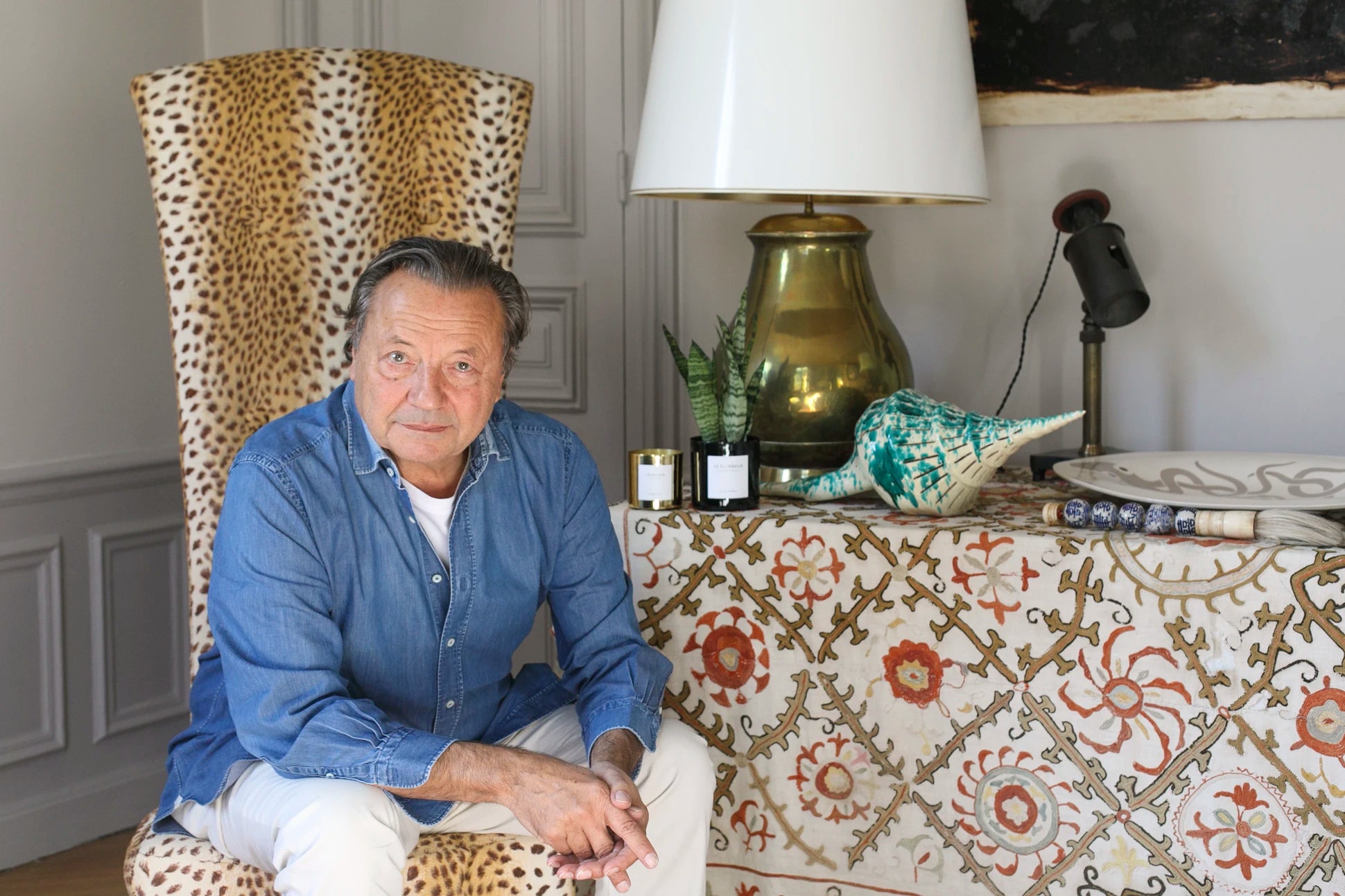
Creativity, a mix of influences and styles, colours and patterns... That's what catches our eye as we step into designer Olivier Gagnère's flat. In fact, everything at Olivier's draws the eye. We hardly know where to look first. Travel mementoes, furniture or trinkets he's designed himself, others given by artist friends... Here we find a wonderful jumble of whimsical, extraordinary objects, every bit as cultured and radiant as the man himself.
Hello, would you care to introduce yourselves?
My name’s Olivier Gagnère, and I’m a designer, though I’m not terribly fond of the word. Let’s just say my job is to design everything that might find its way into a home. I design it all, from floor to ceiling.

Your father was an antiques dealer, you grew up in refined surroundings, how did that influence you?
My father mainly dealt in 18th-century bronzes. I spent my childhood and teenage years in a flat filled with beautiful things, where the décor was forever changing. Depending on what my father found and sold, objects would pass through our home. It was like a great art book, constantly open, as my father would explain to my sisters and me where each piece came from, what it was used for, and so on. That gave me knowledge and nurtured a deep curiosity about objects. I came to appreciate how these pieces of furniture were made back then. It was, for me, an invaluable education that shaped my eye, which is essential.
You're self-taught, by the way, what experiences have taught you the most about the craft?
Being self-taught gives you great freedom. The freedom to do rather as you please. It allowed me to experiment with a great many things. I started out by drawing silverware pieces, and I learnt by going to see craftsmen and silversmiths. Talking with them, I understood how things could be made. I watched them work, I watched them do it.
Imagine you're in a coppersmith's workshop, you see how he works, how he uses all those little hammers to shape sheets of metal. The moment you understand how an object or a piece of furniture is made, you can draw it. And I think art schools don't show enough of how things are actually made. That way, things come naturally. Otherwise, you end up drawing five-legged sheep. It's true that nowadays, with 5D printers, you can create magnificent things, but those things still need to be reproducible with the material you actually want to use.
« Being self-taught gives you great freedom. »

You're constantly exploring materials: what drives your choices of materials and shapes?
What interests me from the outset is the way materials are put to work. It’s true that I’m very sensitive to material, because it’s something visual, something tactile. I’ve always tried to mix materials that, on the face of it, shouldn’t go together, such as a material with a luxurious or rich look alongside something far simpler, even humble. To give you an example, I’ve often used felt. The felt that printers use to make blankets. When they put the paper under the press, they use a blanket, a sort of felt sheet made from rabbit hair.
It's about 3-4 mm thick, and it's used to protect the sheet as it passes under the roller. So it's a very simple material. Originally, it was used in the soles of slippers, the Charentaise type, or to make hats, which are shaped using steam. On its own, it's a material with nothing exceptional about it, but if you make it sing alongside another material, it becomes something far more interesting, giving it depth. What I also love is the way certain materials catch the light. Some absorb it, others reflect it. So depending on the time of day, the objects change.
« What I also love is the way certain materials catch the light. »

What did you love about the By Charlot pots you chose for your home?
What I loved is the simplicity of the shape of these little pots. They're very simple, yet full of lovely details: the curve, the ring around the rim... Their simplicity might seem at odds with what I'm usually drawn to (rather decorative, richly adorned pieces), but in fact, the objects I design always start out very simple, then I layer on elements that create the decoration, whether graphic or sculptural. These miniature pots make a wonderfully delicate setting for plants, almost minimalist. What's also interesting is the whole range of finishes you offer: gloss, matte, semi-matte, gold, and so on. It really lets you compose something with the plant that suits your home, or whatever you have in mind for it. Finally, your succulents remind me of Japanese minimalism. I've travelled to Japan many times and made a great deal of ceramics and porcelain there, and your little pots bring to mind that Japanese refinement. They're deeply attentive to how plants are presented, and they care about every detail. These pots look very minimalist, but their proportions are beautifully thought through. I feel a real connection to objects like these: I find them elegant, but never ordinary.
« What's just as interesting is the whole range of finishes you offer: glossy, matte, semi-matte, gold, and more. »

What is your relationship with greenery in a design-led environment?
I design a lot of ceramics, as well as vases and containers. I love flowers, cut flowers especially, I find them truly beautiful. I'm not very gifted at arranging plants or flowers in a vase, but I do love designing their containers. Everyone should let their imagination run free, and I've created many vases, because I think it's so important to have plants or flowers at home. There needs to be that touch, otherwise things feel a little bare.

At By Charlot, the art of giving is placed centre stage, and we firmly believe in the sentimental value of an object. What relationship do you have with the objects you create?
The main driver of creation is passion. So I naturally feel more drawn to certain objects than others, but it's clear that when you design an object or a piece of furniture, you have to think about its ability to stand the test of time. This object also needs to be able to grace a very contemporary interior just as easily as a very classic one. It's only once it has that capacity to blend into its surroundings that it can truly be called a success. So when you have an object that, to your eye, sits beautifully within your interior, an affection for that piece naturally takes root. You become attached to it, you take care of it. If it were no longer there, you'd feel its absence. For me, it's clear that we have an emotional relationship with the things around us.
« It really matters to have plants or flowers at home. You need that touch of green, otherwise things feel a bit bare. »

What inspires you, and how do you nurture your creativity?
My sources of inspiration are many. Before anything else, if you want to create, you need to know how to look. You must have the ability to observe what surrounds you, even the smallest details. A detail in a painting, a detail of a garment or a building, can catch your eye, hold your attention, and strike a chord. It's often from a single detail that I begin to sketch a piece of furniture or an object. Inspiration is like a draught of air: sometimes it blows through strongly, other times you barely feel it. Often an idea comes to you straight away, the rest of the time you have to let it simmer a little. During lockdown I did a great many things in my workshop, tidied up my archives, which are rather substantial, and immersed myself once again in my drawings.
There are things I had completely forgotten. I realised I’d sometimes redrawn things I’d designed 25-30 years earlier, occasionally with a variation. It amused me no end, because it proves that sometimes you have a flash of inspiration, the idea feels right, and for whatever reason it isn’t in step with the times, people aren’t convinced, and 10 or 15 years later you redraw, quite by chance, this object you’d forgotten about, and all of a sudden people say "It’s superb!". It’s always funny, it tells me I wasn’t wrong, because deep down I knew the object was good. To me it was interesting from the very start, but I forgot about it because nobody wanted it. There are no rules, what matters is to look, to be curious. If you’re not curious, you’re not creative.
« It's often from a single detail that I begin to design a piece of furniture or an object. »
What's the thing you haven't yet imagined but secretly dream of?
Perhaps a sailing boat. I rather like that idea. I find sailing boats quite beautiful and I love the sea. Perhaps I could design one myself one day...

What would he be like?
It wouldn't necessarily be big. I started sailing as a kid, dinghies to begin with, and I have some rather fabulous memories of it. The way they were built, the shapes I found magnificent... At the time, they were very fast, sporty dinghies, the first ones that could plane over the waves. Those were my first real thrills. That feeling of surfing the waves left me with a wonderful memory, and one day I'd love to design a dinghy that can surf... without it being like those foils, those incredible machines that lift off the water but look like flying insects. I'm picturing something more noble, more classic, where the hull glides over the water and you can feel the spray... So there it is, perhaps that's a glimpse of my next dream.


